

Party of One
When loneliness becomes a lifestyle brand


Nothing says a civilisation is thriving quite like teaching people to enjoy eating alone.
That’s the tale we spin, anyway. The squeaky clean Persil Non Bio version. The one with the little marble table from Italian Furniture Direct, the glass of natty wine from the bottle with the angry rubber hose mascot, the half-started paperback copy of Perfection, the post about six empowering solo dating ideas with the caption about hoping to inspire others to take their first step towards independence.
And to be fair, some of that is true. A meal alone can be a beautiful thing. Solitude is not a pathology. A quiet table in the shade on a warm spring afternoon can feel like finding a freshwater pearl in pig shit. But there is an enormous difference between choosing your own company and being left with nothing but it. Psychologists have been careful for years to distinguish solitude, which is usually chosen and restorative, from loneliness, which is not. Anyone who’s felt entirely unseen and alone in a room of friends has bathed in that same cold water. [1]
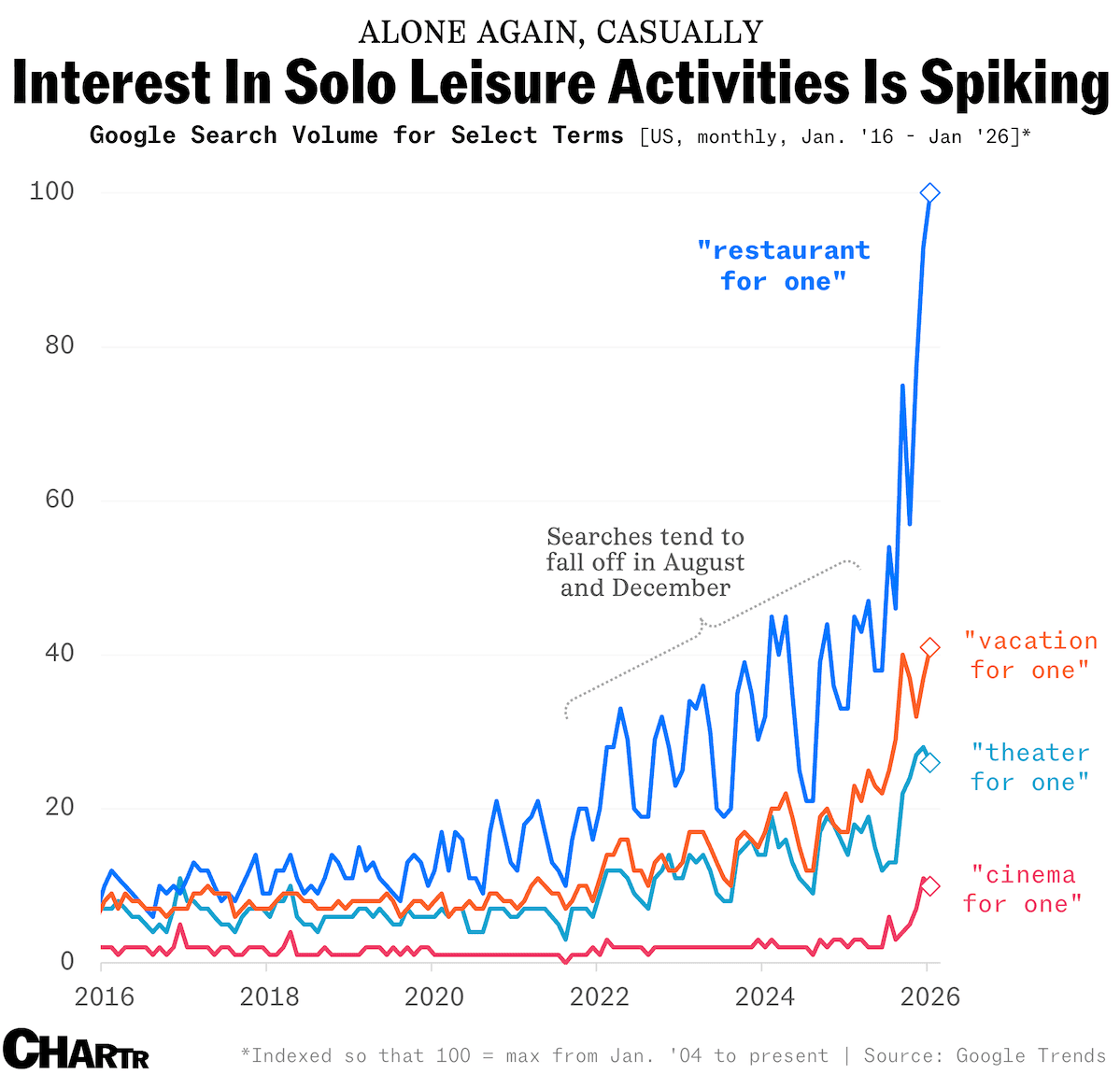
But this graphic from Chartr complicates the tidy and disenchants the empowerment. Searches for “restaurant for one”, “vacation for one”, “theatre for one”, “cinema for one” have all been ascending. The incline of the slope is the plume of smoke from the wreckage, a few people discovering solo leisure would be one thing, a culture visibly tilting their blooms towards that sun is another thing entirely.
The question it raises isn’t whether being alone can be good, because of course it can, but rather what it means when a society starts dressing loneliness as aspiration at precisely the moment the social fabric starts to disintegrate in our hands.
Loneliness is expensive, it’s also inflammatory, and once it enters a body haunts from within. The World Health Organisation’s commission on social connection now estimates that loneliness affects one in six people globally and is linked to more than 871,000 deaths a year.[2]
The World Happiness Report similarly has a finding that should make every finance minister and public health official lay awake at night: sharing meals with other people is as strongly associated with wellbeing as income and unemployment are.[3]
That same report highlights how in the United States the number of people eating all their meals alone has risen by 53% in two decades. Yum’s food trends report says solo orders have grown 52% since 2021 and now account for 47% of quick service dining occasions.[4]
Nobody reading this will be shocked by the world’s largest brands finding ways to strip mine opportunity from a global health crisis. The decision science here is what fascinates me. It’s not simply that people are alone, but that they have found utility in allowing themselves to be conditioned into believing that isolation is aspirational.
One of capitalism’s oldest tricks is taking a stab wound and relaunching it as a lifestyle choice. The most successful in living memory is the rebranding of overwork as hustle, the silver medal however goes to repositioning loneliness as confidence.
The Lonely City Redux
Olivia Laing saw some version of this a decade ago, long before #SoloSashimi trended on TikTok. The Lonely City begins with a very modern sort of hole in the heart, a British woman arrives in New York after a relationship collapse and finds herself marooned in a city that promises intensity, glamour and fresh blood, and instead discovers how loneliness in a crowd only thickens the arteries.
I adore Laing’s writing, I wouldn’t be shocked if in a hundred years time English Lit students have framed pictures of her on their dorm room desks. The brilliance of the book is that it refuses the cheap seat experience of loneliness. It goes beyond private sadness, and illustrates the flecks of it hidden in the mortar of our architecture, how the artists of social isolation sign their names on their works of economics. That loneliness is a thin cold fog that hangs around the periphery of all life, imitating the dull drone of a neon light questioning how much longer it must exist before it’s finally laid to rest. Laing paints loneliness as a social condition that has always settled around a person unnoticed, like the weather. [5]
That still feels true, but in the decade since if was first published we’ve become much more adept at romanticising poor weather.
The solo table, the solo holiday, the solo cinema seat, the solo flat, the solo walk home with a podcast about empowerment through productivity, accompanied only by an iced ube vanilla velvet matcha latte and the latest Korean glass skin serum in a personalised tote bag. There is nothing inherently bleak about any of those things. But there is something revealing about how urgently we now need to brew a fog of narrative to prove these acquisitions are symbols that we are flourishing.
That urgency instead suggests the story is social pink slime. Filler used to bulk out the quiet moments in life, until the whole day is diminished into cheap burger meat.
People who are securely embedded in social life do not usually need to keep posting evidence that they are happily unaccompanied. They just live. It is when the social world becomes unreliable that independence becomes insecure and starts needing to look immaculate.
And this is where Bourdieu comes stalking into the room, cigarette first, to waft champagne breath on our clean little fantasy about freedom.
Taste is Never Just Taste
Bourdieu’s central point in Distinction was not merely that some people like opera and others like the ice hockey. It was that taste is social hierarchy disguised as preference. What feels natural to us, what seems elegant, vulgar, crass, refined, embarrassing, aspirational, is entirely shaped by our cultural capital, by the habits and sensibilities absorbed early enough that they no longer feel learned at all.[6]
That early acquisition of taste is what really matters. You can’t bulk it out with pink slime at a later date.
Bourdieu’s most useful and most quietly savage observation is that dominant culture rewards forms of knowledge and taste that appear effortless. If you grew up with the right accents, references, museums, books, table manners, and ease in institutional spaces, it reads as innate. If you acquire those things later in life through hunger, labour or self-reinvention, it reads as striving. And effort is embarrassing. It’s a sign that your algorithmic feed has conditioned you to think performative hustle is true culture, rather than good marketing to push up the price of cheap burgers.
The same logic now governs solitude.
Doing things alone is not socially neutral, it is coded, a white door painted black. A lonely person posting pictures of themselves eating alone is a figure of lack. A tasteful person eating alone is a figure of poise. The behaviour is identical, the class reading is not.
This matters because it helps explain why solo life can become desirable even as social connection deteriorates. People are accepting less, while attempting to convert necessity into cultural capital. If belonging becomes further unreliable, then at least loneliness can be dressed up with a bow and made to look discerning. A table for one can transcend beyond being a sign that something is missing, into a performance of personal brand.
And once something becomes a personal branding exercise, the market can monetise it.
But not by solving the upstream loneliness, the market instead focuses on offering solutions for the optics by damming the choke points downstream. It acquires and markets you the right restaurants, the right hotels, the right cutlery, the right matcha, the right skincare, the right shade of sambas, the right lexicon, the right narrative arc in which doing everything alone doesn’t mean your world is shrinking in the shadow of productivity, it means you have standards.
In an age where the utility of brand and marketing has been questioned like never before, I actually find it heartening to see the first shoots of spring bursting through the tarmac, even if they’re carnivorous blooms.
For flowers will forever grow from the ruins of empires.
Women, Men, and The New Companion Economy
The dating market sits right in the middle of this shift.
For a long time, heterosexual relationships operated on a reasonably transparent bargain. Men provided, women tolerated, and that degree of tolerance was inversely related to the number of real economic alternatives available. That is not the only story of marriage or partnership, but it has been a major one. Marriage for love is less than two hundred years old, women have been allowed their own bank accounts in the UK for just over fifty years, marital rape has been a crime for even less time than that. These planets all orbit the same sun.
The sun is setting on the provider model though, the hand of man has weakened, and with it the illusion that provision alone is enough to make a man desirable. Hinge’s 2025 data found that 63% of heterosexual men still feel some pressure to be a financial provider, while only 6% of women said they expect a partner to be the sole provider. Which means a lot of men are still revising to pass an exam that women are no longer checking the results of.[7]
Women are increasingly looking not for providers but for companions. A softening from “Is he someone I can trust to build a home with and to not abandon me and our unborn children?” to “Is he someone I would willingly share a lifetime of midnight Jewish deli sushi with?” That shift to softness has been brutal to a large number of men who weren’t raised to be weighed and measured on if they are interesting, emotionally literate, pleasant, socially competent, intellectually curious, charming, humble, and of good taste and humour. The average man has never considered if he adds peace or subtracts it.
We are asking for companionship at the exact moment culture is making the acquisition of taste, interests, emotional range, and social fluency impossible without embarrassment. To purposefully chase becoming cultured later in life is performative cringe. The ability to care about things beyond the self, even if done performatively, is withering. The social premium sits not just on taste, but on effortless taste. This is Bourdieu’s world.
Some men deal with this by growing, some do not, as it is a considerable investment of time and risk to better the self. It’s a lot easier to drift into communities organised around grievance, humiliation and resentment. The literature on incel communities describes them as networked subcultures of romantic exclusion and misogynistic victimhood, held together by a shared narrative that intimacy has become inaccessible and the social game rigged against them.
These men of worth, who in a properly ordered world wouldn’t need to be emotionally literate, curious, charming or humble, as they would simply earn enough to buy their wives poorly fitting lingerie and cover the cost of a salon appointment every other month.
Some men have responded to not being chosen by deciding that being a man worth knowing is beneath them.
Meanwhile, many women look at the available options and make what is a fairly rational decision.
Dinner for one.
The Number I Want But Can’t Yet Calculate
I keep coming back to what I call relational welfare. The thing I discussed with ChatGPT and it told me I’d eventually win a Nobel for.
We have GDP, wage growth, inflation, house prices, productivity, labour market participation, diminishing marginal utility, consumer confidence, purchasing power, discretionary spend, we even now have GMV. We can tell you what a country actively produces beyond the decimal place while remaining vague about whether its people are actively happy or socially alive.
How many shared meals does a healthy week contain?
How many people can you call in a crisis?
How many relationships in your life are not transactional?
How many people would notice your absence quickly enough for it to matter?
I no longer want questions like these to be seen as soft qualitative psychology fluff, but as questions of social infrastructure.
If shared meals predict happiness as strongly as income does, then social connection is more than the side salad of life. It is not what remains after the serious economics is done, it is part of the health burden, part of the riddle of productivity, part of demand forecasting, part of the irrational human heart of predicting risk, the racoons in the coat masquerading as cold academic logic in the spreadsheet. It is part of whether a society can withstand shock without atomising completely. The Waffle House index in the coal mine.
And once you start looking at things that way, the table for one changes shape.
It is no longer just an aesthetic image of poise or sadness. It becomes a data point in a much larger story about what kind of lives we are making possible.
If damming the downstream for short term gains to temporarily pump real GPD, appeasing the Gods of quarterly earning sheets, is done so by pruning the blooms of long term sustainable growth, both of the market and the community the suffer in it’s shade.
The Part I Find Hardest to Say Aloud
I don’t think the danger is that people are going to the cinema alone, I don’t even think the danger is that women are buying themselves succulent Chinese meals and refusing the company of disappointing men. That sounds less like the decline of western civilisation and more like evolutionary optimisation.
The danger is what happens when self sufficiency becomes the only respectable response to systemic social collapse. When chronic aloneness is no longer a warning sign or diagnostic criteria, but a sign of sophistication. When belonging becomes so unreliable, so administratively heavy, so romantically unrewarding, so culturally undernourishing, that the most realistic human response is to become beautifully, tastefully, impeccably alone.
A planet inhabited by billions of Holly Golightlys with ring lights is neither liberation nor rebellion.
The market will always be able to sell you a more aspirational washing powder, or package together a better solo trip with fifty other solo travellers to enjoy a better small plate of beignets dusted with rose pink icing at the best Parisian bakery in Glasgow. A better phone with the perfect camera to capture content in front of their immaculate flower wall, under flattering low light, while AI writes you the perfect caption about hoping to inspire others to take their first step towards independence, based on the thousands of identical posts it’s written for others who’ve visited the same bakery in cities and towns all over the world.
It’s easier to monetise a stab wound than to heal the conditions that caused it, easier to beautifully set a table for one than to create the conditions in which community might take root in a world where taste is, first and foremost, distaste.
[1] A. Rokach, “Loneliness or Solitude: How Are They Different?” Neurobiology (2025).
[2] World Health Organization, “Social connection linked to improved health and reduced risk of early death” (30 June 2025).
[3] World Happiness Report 2025, chapter on sharing meals and social connection (2025).
[4] Yum! Brands, 2026 Food Trends Report and related coverage on solo dining growth (2026).
[5] Olivia Laing, The Lonely City: Adventures in the Art of Being Alone (2016).
[6] Pierre Bourdieu, Distinction (1979).
[7] Hinge, “Cuffing Season 2025” (2025).